For a domain investor, spreading your portfolio across multiple registrars and platforms can seem like a sensible strategy.
Perhaps you bought some domains through an auction platform. Others came from a different registrar because the pricing was better. You may have moved another group to a platform offering a particular monetization service.
Before long, you have domains everywhere.
One registrar for these names.
Another for those.
A separate platform for parking.
Another marketplace for sales.
And perhaps a spreadsheet somewhere trying to keep track of it all.
On paper, this can look manageable.
But there’s a cost that doesn’t always appear on your monthly statement:
Your time.
And as a portfolio grows, that hidden operational cost can become surprisingly significant.
The problem with “I’ll keep track of it”
Managing 20 domains across several platforms probably isn’t particularly difficult. Managing 500 is different. Managing 5,000 is different again.
Every additional platform potentially creates another:
- Login
- Dashboard
- Renewal calendar
- DNS interface
- Account balance
- Set of pricing rules
- Set of security settings
- Transfer process
- Reporting system
- Source of domain data
- Multiple places to update credit card details
None of these tasks is particularly difficult on its own. The problem is the repetition.
You might spend five minutes checking one account, another five minutes checking a second, and then another 10 minutes reconciling information with your spreadsheet.
Do that regularly across a large portfolio and the minutes start becoming hours.
And hours spent on administration are hours you’re not spending on acquisitions, sales, research, or strategy. And the more you have the more errors you can make.
The hidden cost isn’t just logging in
It’s easy to think the time cost of multiple platforms is simply the time spent logging into different accounts.
It’s much more than that.
Consider a typical renewal decision.
You need to know:
- When does the domain expire?
- What is the renewal cost?
- How much revenue has it generated?
- What traffic has it received?
- Is it listed for sale?
- Has it received offers?
- What is its ROI?
- Should I keep it?
When that information lives across different platforms, you may need to gather it before you can decide.
That creates what you might call portfolio friction.
The information exists.
But it’s not necessarily in the same place.
The spreadsheet trap
Spreadsheets can be incredibly useful for domain investors.
But they can also become a symptom of fragmented portfolio management.
You might have columns for:
| Domain | Registrar | Expiry | Renewal Cost | Revenue | Traffic | Asking Price |
The problem isn’t the spreadsheet itself.
The problem is keeping it accurate.
Every time you buy a domain, transfer one, sell one, change DNS, update a price or renew a name, your spreadsheet potentially needs updating.
Miss one change and the spreadsheet becomes less reliable.
Then you’re no longer using the spreadsheet to manage the portfolio.
You’re managing the spreadsheet.
Above.com has long focused on reducing this problem. Its Portfolio Manager and Consolidator tools are designed to bring information such as registrar, expiry, renewal cost, revenue, traffic and ROI into a central view.
The renewal problem
Renewals are one of the clearest examples of where fragmented management can become expensive.
Imagine you own 2,000 domains across four registrars.
Your domains don’t necessarily expire on the same day.
Every month, you could have names approaching renewal at different platforms.
If you’re manually checking each registrar, you have to remember:
- Which domains are expiring?
- Which registrar they’re with?
- What each registrar charges?
- Which domains are producing revenue?
- Which domains have traffic?
- Which domains have offers?
- Which names should be dropped?
And perhaps most importantly:
Which renewals are actually worth paying for?
Above.com’s Consolidator tool monitors expiration dates across registrars and allows investors to view domains approaching expiry at 30-, 90- and 120-day intervals. It also brings revenue and ROI information into the renewal decision process.
That changes the question from:
“Which domains are expiring?”
to:
“Which domains are worth renewing?”
That’s a much more useful question.
The cost of making decisions without the data
There’s another hidden cost to fragmented systems:
Decision-making becomes harder.
If you can’t easily see the relevant information, you’re more likely to make decisions based on memory or intuition.
You might renew a domain because:
“I think this one gets decent traffic.”
Or:
“I’m pretty sure it made money last year.”
Or:
“I don’t remember what I paid for it, but it was probably worth keeping.”
Multiply that across hundreds or thousands of domains and small mistakes can compound.
Above’s Portfolio Manager is designed to bring revenue and cost opportunities into view, while its renewal decision reporting combines performance and ROI information with upcoming expirations.
The objective isn’t simply to give you more data.
It’s to make the right data easier to act on.
Multiple platforms also mean multiple workflows
It’s not just registrars.
A serious domain portfolio can involve several separate functions:
Registration
Where the domains are registered and renewed.
Monetization
Where traffic and revenue are managed.
Marketplace
Where domains are listed for sale.
Brokerage
Where larger acquisitions or sales are negotiated.
Analytics
Where you monitor traffic, revenue and performance.
Each platform might be good at its individual job.
But the investor is left connecting the dots.
That’s where time disappears.
Above.com was built around bringing registrar, monetization and marketplace functions together. Its Portfolio Manager combines tools from these areas into a single dashboard, while still retaining the underlying functionality of each service.
The five-minute task that isn’t really five minutes
Let’s take something simple:
Change the DNS settings on 100 domains.
On a platform with bulk management, that might be a straightforward batch action.
Across multiple registrars, it could mean:
- Log into registrar A.
- Find the domains.
- Make the changes.
- Log out.
- Log into registrar B.
- Find the domains.
- Make the changes.
- Repeat.
And that’s assuming you already know exactly which domains are where.
Above’s registrar supports bulk actions including DNS changes, renewals, transfer approvals, EPP code requests, domain locking and privacy settings.
The benefit isn’t that any individual task is revolutionary.
It’s that repetitive tasks don’t have to be repeated individually.
Time is an investment cost too
Domain investors are generally very conscious of financial costs.
You track:
Acquisition price
Renewal costs
Marketplace fees
Parking revenue
Sales commissions
But how often do you calculate the cost of your own time?
Suppose managing a fragmented portfolio takes an additional five hours per month.
That’s 60 hours per year.
If your time is worth $50 an hour, that’s effectively:
$3,000 of annual opportunity cost.
At $100 an hour, it’s:
$6,000.
And that’s before considering the value of what you could have done with those hours.
Of course, the actual time cost varies enormously depending on portfolio size, workflows and how much automation you already use.
The point isn’t that every investor is losing exactly a certain amount.
It’s that time is an operating cost — even when nobody sends you an invoice for it.
Fragmentation can also create missed opportunities
The biggest cost may not even be administration.
It could be the things you don’t notice.
A domain might:
- Start generating more traffic.
- Become a strong monetization performer.
- Receive an offer.
- Approach expiry.
- Become expensive to renew.
- Be sitting unlisted when it could be for sale.
- Have a better ROI than another domain you’re continuing to renew.
If that information is buried across several dashboards, identifying those opportunities becomes harder.
A centralised portfolio view can make patterns easier to spot.
Above’s current platform, for example, brings portfolio information together and includes filtering, reporting and bulk management tools designed specifically around domain investors’ workflows.
Does that mean you should use only one registrar?
Not necessarily.
There can be legitimate reasons for spreading domains across providers.
Some investors may want diversification.
Others may use different platforms for specific TLDs, acquisition channels, pricing structures or operational requirements.
The goal isn’t necessarily:
“Put every domain in one account.”
The better question is:
“Does the benefit of spreading my portfolio outweigh the additional management cost?”
For a small portfolio, the answer might be yes.
As your portfolio grows, the answer may change.
Consolidation doesn’t have to mean losing visibility
One concern investors can have about consolidation is losing track of where everything came from.
In reality, a centralised system can provide more visibility, not less.
Above.com’s Consolidator shows domains held at other registrars alongside domains already at Above and identifies eligible domains that can be transferred. It can also show potential annual savings based on renewal pricing.
That means consolidation doesn’t have to be a blind process.
You can identify:
- What’s where
- What’s expiring
- What it costs
- What is eligible to transfer
- What you could potentially save
- Which domains need action
Then decide what makes sense.
The goal isn’t fewer platforms. It’s less work.
This is perhaps the most important distinction.
Portfolio consolidation isn’t valuable simply because you have fewer logins.
It’s valuable because it can reduce the amount of manual coordination required to run your portfolio.
You want your systems to do more of the repetitive work.
You want your data to come to you rather than having to hunt for it.
And you want to spend your time making decisions rather than collecting the information required to make them.
What should a domain investor automate?
Start with the repetitive tasks.
Renewal monitoring
Know what is expiring and when.
Renewal decisions
Combine expiry dates with revenue and ROI data.
DNS management
Make changes across groups of domains rather than one at a time.
Portfolio reporting
See registrar, revenue, traffic and cost information together.
Transfers
Track domains moving between registrars.
Sales listings
Identify domains that aren’t listed or need pricing information.
Privacy and security
Apply relevant settings in bulk.
Above.com’s platform includes many of these capabilities, including bulk management, reporting, transfer tracking and renewal decision tools.
Your portfolio should work harder than you do
Domain investing already involves plenty of decisions.
Which names should you acquire?
Which should you sell?
Which should you hold?
Which should you renew?
How should you price them?
How should you monetize them?
The last thing you need is to spend hours moving between dashboards just to find the information required to answer those questions.
A portfolio of 100 domains might tolerate some manual administration.
A portfolio of 1,000 or 10,000 domains can’t be managed efficiently in the same way.
Scale changes the economics of administration.
What takes 10 minutes at 100 domains can become hours at 1,000.
And what takes hours at 1,000 can become a genuine operational problem at 10,000.
Look beyond the registration price
Domain investors are understandably focused on getting the best possible registration and renewal pricing.
Above.com operates an ICANN-accredited registrar with cost pricing on registrations, renewals and transfers for supported extensions, alongside free WHOIS privacy and bulk management tools.
But the bigger opportunity may be looking beyond the price of each individual domain.
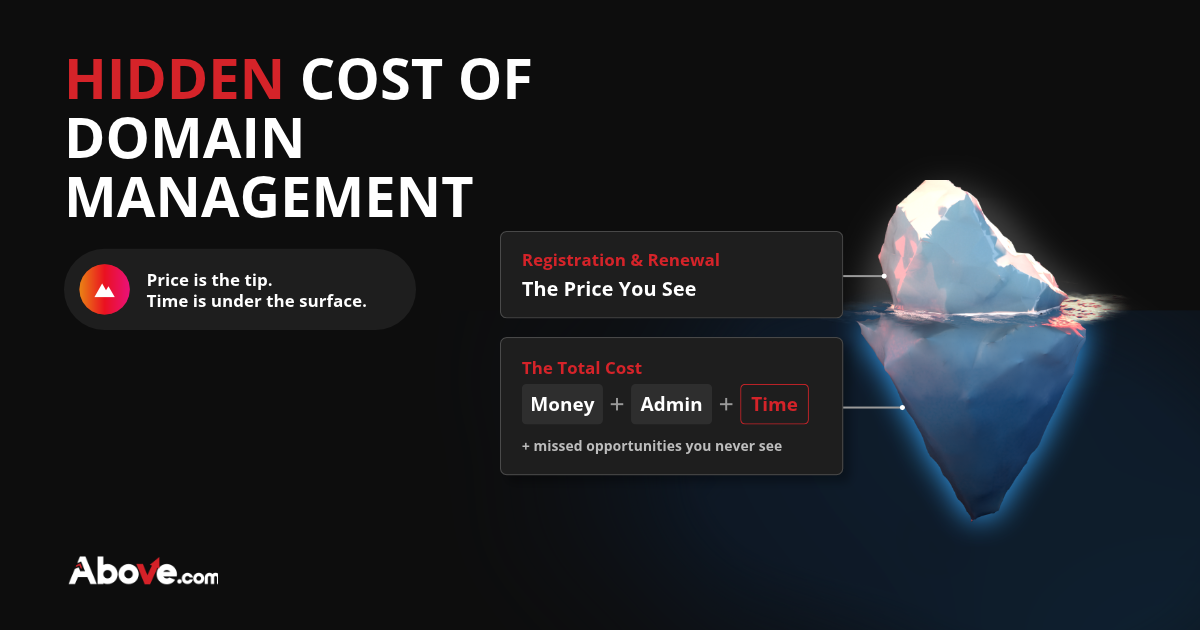
Consider the total cost of managing the portfolio.
That includes:
Money + time + administration + missed opportunities.
A registrar that saves you a few cents per domain is useful.
A platform that saves hours of portfolio management can potentially be much more valuable.
The real question: what is your time worth?
If you have a growing domain portfolio, take a moment to calculate how much time you’re actually spending managing it.
How many platforms do you log into each month?
How many spreadsheets do you maintain?
How long does it take to check upcoming renewals?
How long does it take to update DNS?
How much time do you spend comparing revenue against renewal costs?
How often do you manually reconcile information between platforms?
And how much time could you spend on higher-value activities instead?
Acquiring better domains.
Negotiating sales.
Researching markets.
Improving monetization.
Analysing your portfolio.
That’s the hidden opportunity cost of fragmented domain management.
From portfolio management to portfolio optimisation
The ultimate goal isn’t simply to make your portfolio easier to administer.
It’s to make it easier to manage intelligently.
When your registrar, monetization and sales data are connected, you can start looking at your domains as a portfolio rather than as thousands of individual names.
Which domains are earning?
Which are costing you?
Which have strong ROI?
Which are approaching renewal?
Which are for sale?
Which aren’t performing?
Which deserve more attention?
That’s where centralised portfolio management becomes more than a convenience.
It becomes a decision-making tool.
Three Questions to Ask About Your Portfolio
Before you decide whether your current setup is working, ask yourself:
1. How many hours do I spend managing my domains each month?
Don’t estimate based on individual tasks. Add up the logins, spreadsheets, renewal checks, DNS changes, transfers and reporting.
2. Can I see the information I need in one place?
If you need three or four platforms to work out whether a domain is worth renewing, there’s probably an opportunity to simplify the process.
3. Am I spending time managing domains instead of investing?
This is the biggest question.
Your portfolio should be an investment. It shouldn’t become a full-time administration job.
The Bottom Line
Managing domains across multiple platforms might seem harmless when your portfolio is small.
But as the number of domains grows, fragmentation creates a hidden cost.
More logins.
More spreadsheets.
More manual updates.
More opportunities for errors.
More time spent collecting information.
And potentially more missed opportunities.
You don’t necessarily need to move every domain to a single registrar tomorrow.
But it’s worth calculating what your current setup is really costing you — not just in dollars, but in hours.
Above.com’s Portfolio Manager and Consolidator tools are designed to bring registrar, renewal, revenue, traffic and portfolio data together, with bulk actions designed to reduce repetitive work.
Because ultimately, the goal of better domain portfolio management isn’t simply to make your domains easier to find.
It’s to make your time more valuable.
Frequently Asked Questions
Is it bad to have domains across multiple registrars?
Not necessarily. There can be legitimate reasons for using multiple registrars, including diversification, TLD availability, pricing or acquisition channels. However, as a portfolio grows, managing domains across multiple platforms can create additional administrative work. The important question is whether the benefits outweigh the extra time and complexity.
How can I save time managing a large domain portfolio?
Look for opportunities to centralise information and automate repetitive tasks. Bulk DNS changes, renewal monitoring, transfer management and portfolio reporting can significantly reduce manual work. Above.com’s Portfolio Manager and Consolidator tools are designed specifically to bring many of these functions together for domain investors.
Should I move all my domains to one registrar?
Not necessarily. Consolidation can simplify management and potentially reduce costs, but every investor has different requirements. Start by analysing where your domains are currently held, what you’re paying, how much time you’re spending managing them and which domains are eligible for transfer. Then decide whether consolidation makes financial and operational sense for your portfolio.